The Cartoons my mother did
I was exposed to painting and cartoons very early in life. My mother painted frequently with pastels and sometimes watercolor. She also considered becoming a cartoonist but was persuaded against it. However, she persisted in the habit of drawing them and I used to see those cartoons. I do not have a clear recollection of me being impressed by this at any specific point, but it became a part of the activities I used to do as a child.

Cartoons together with the stories I would hear my parents tell impacted me. I became someone who is very fond of stories and of telling things in story format. You can see it in the way I write and talk, how I teach and even on how I write my own research papers. It is always a story.
Saint Seiya
I grew up watching many cartoons. The one that caused an immense impact to me was Saint Seiya. It is hard to pinpoint what was it of this cartoon that created such a maelstrom of emotions to me: the topics that were treated, the music itself, the colorful images and the dramatics. I connected to this cartoon and to this day I have not been able to lessen the impact of it.
Many times, I have rewatched the original 72 chapters of the series. There are certain chapters I know by memory (or at least I did, my memory is not what it used to be anymore). I continue to rewatch certain episodes, that have special meaning for me, from time to time.
In more than one occasion, when I struggle to communicate an idea to my friends, I bring events of this cartoon to explain the ideas. It helps me connect with people, but it has also informed my ways to react to situations.
Manga and Anime
When I was about eight years old, anime and manga had a boom in Mexico, where I was growing up. A cousin of mine got very much into Sakura Card Captors and we started watching it together. Being children, we decided to play that we were the characters of the cartoons. I was Shaoran and she was Sakura and we, together, trapped the monsters in the cards in epic tales that happened all over the place. Very soon we were inventing our own cards and powers.
She also got into drawing in the style of Manga. We used to go through Mexico City looking for material to make drawings. Back in the day internet was not what it is now, and we could not just download things easily or watch them online, so we actually had to go to stores and markets to find the things we wanted: the next manga chapters, the markers or the new anime video that was out. This of course led us to the comic conventions, cosplays and all sort of amateur drawing.
Adaptations, Spin offs and my own Stories
By that time, I had been drawing cartoons of my own based on stories of my mother. This motivated me to think on other things beyond that. Distinctively I remember I going to a random store and buying a toy. This was a random toy machine: you paid 10 pesos, and you got a cheap bad toy. However, this toy made me think on a cartoon. It came to me in flashes that is hard to convey, but I saw how it would develop (not very deep, I was eight years old).
I told this story to my cousin and that became our new object of exploration. We now played this story we were discovering. I enjoyed not only playing it but also drawing it. It was this what led me to try to write my own stories and adapt the stories I saw into different versions. I have always liked this since then: see stories and think how I would have done it differently. Could I improve it? Change it? Could I make a spin off exploring something different?
I created a lot of cartoons in this way. Of course, several of them are adaptations of the cartoons or stories I used to see. The two big ones back then were Saint Seiya and Star Wars.

Rings and Epsilon – Delta
My cousin grew up of the cartoon obsession, but I did not. For me cartoonism became a huge component of my life. Storytelling was fundamental and to display it in paper, with drawings and colors was deeply important for me.
I decided to develop the cartoon that started from the toy I bought randomly in a more careful way: their characters, their plot, the way the interact and the goals they have, etc. I started to do this properly around twelve years old and I continue to do so. This cartoon has the name Rings (Anillos in Spanish), and I have been developing it for a very long time.
However, I decided that should not be the first cartoon I do properly. I needed to get more practice doing cartoons. When I was 21, I decided to start a cartoon that I would consider my “practice” cartoon and I would allow myself to be free with it, as long as I could indeed learn about what does it mean to draw a cartoon. This cartoon became Epsilon – Delta and is a cartoon I have been drawing for more than a decade now.
I have realized that when you develop a story, you know many parts of the story, but you discover the story as you move along. You get to discover who your characters are and, eventually, up to a point they develop their own being that fights to be independent of you. One of the main traits of this cartoon is that I tried to embed mathematical ideas into it without making it a teaching math cartoon. This is a cartoon of adventure and drama in another world. However, on many occasions what I learn and see of mathematics informs me of how to do things in the story, whether it is in the powers of the characters, in the development of the plot or even in the name of objects. The mathematical experience, as opposed to the mathematical content itself, is very present as well in it.
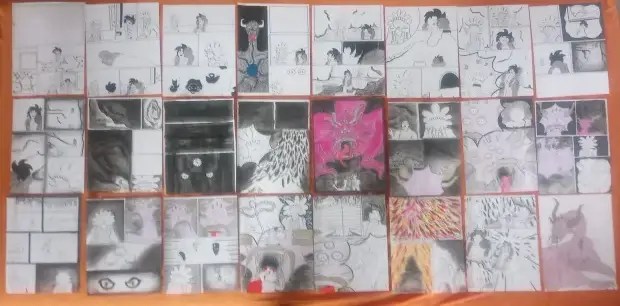
Through the years I have developed many cartoon stories. I unfortunately do not always have the time or energy to do all of them, however I do keep pushing Epsilon – Delta. Eventually, I will go for Rings itself.
Terror, Mathematics and the She – Rat
I have always found terror a very important dimension that an object can possess. Of course, mathematics can have a terrible dimension. When I refer to this dimension I do not only mean that it can actually be difficult, but something more intrinsic to it.
Why can mathematics, the environment as well as the mathematics themselves, can be terrible?
I think of this question very frequently and engage with the thoughts of what part of it can be avoided and which ones cannot. I do believe there is a percentage of it that could be avoided with better preparation, perspective, openness, opportunities, funding, direction, etc. However, I also believe there is a part of it that is simply part of what mathematics is.
A part of mathematics is founded on terror.
I find this realization very powerful and engage in it via cartoons and the creation of characters. I do not mean that I invent the characters, as I maybe would for a short story. Rather, the characters have appeared to me as I move through my mathematical path. The most important of them to me is the She-Rat: the representation (for a lack of a better word) of the madness of the academia.
The She-Rat presented to me in the novel The Rat from Günter Grass. In there, of course, is not the She-Rat that am discussing above but the first versions of it come from it. However, as I grew up academically, I started to see its real contours and depth as in independent force of nature. It presents frequently to me in my stories, in my essays, in my cartoons and in the way I understand the environment I develop in.

Ultimately, I find it fruitful to understand what does it give to mathematics its terrible dimension? And how do we engage with it. I find that the powerful mediums of the colors in painting are a way to express this part of the science that those that go through it experiences but that many times struggle to locate.
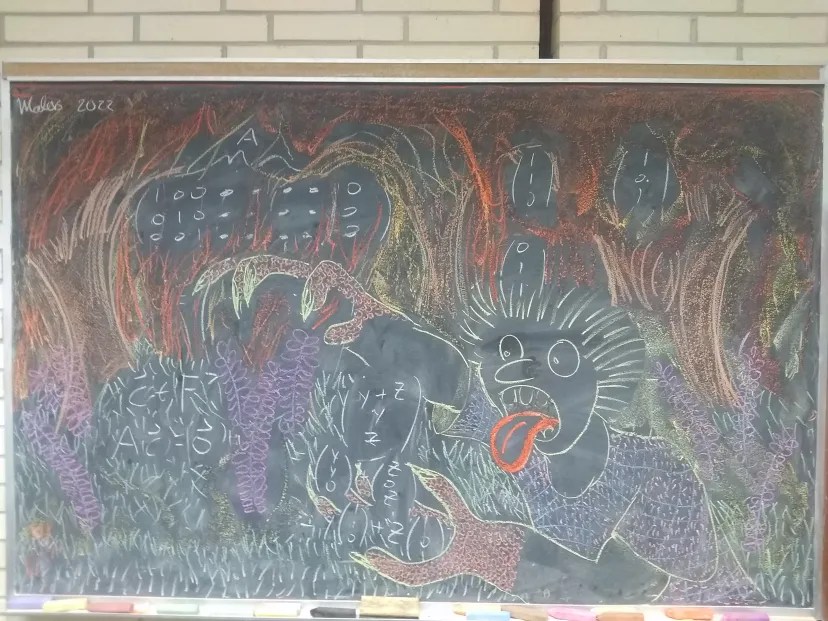
Terror must be acknowledged. That doesn’t mean we honor it or that we look for it, but we must recognize it is always there.

Cartoons and Art
As I have engaged in these explorations of cartoons, and stories, and mathematics I came to the conclusion that there must be something in the cartoon beyond the story. One poem of Philip Larkin that played a role in my Ph.D. experience is Church Going. At some point it says:
But superstition, like belief, must die,
And what remains when disbelief has gone?
I like playing with this verse and change the words. In particular, when we discuss cartoons, I would use the second line but changed to
And what remains when the story has gone?
The answer to that question is the essence of what a cartoon really is, and I think is where the real artistic potential of them lies. I do think that cartoons with story can be artistic, but a cartoon that really shines is one without it. I am still exploring what this means but it is a question that moves me.


What I think is my best cartoon?

But I will not tell you why 🙂
 Malors