What was the question?
There are three irreducible affine Coxeter Groups whose Coxeter Complex is three-dimensional space. In this space we can find all knots, but if now we use the tessellation that come from the Coxeter group we get that the knots produce galleries (if we avoid vertices and edges). The question I asked the students was: what type of words produce what types of knots?
What motivated me?
I really like Coxeter Groups and the theory of Buildings. Thus, I thought it would be interesting to make a table of how different words produce different knots. I was motivated by some knot maps I saw in other areas, where the question was about changing the knot type when intersection happens (i.e. we have trivial knot world, and trefoil country and so on) and on the border are singular crossings. This is of course the area associated with Vassiliev Knot invariants, which I find quite interesting.
What did the students do?
The first part consisted of understanding what a Coxeter Group is and how we use it to codify galleries. Fortunately for us, the students were very good at coding images and thus we were able to have a program that given a word produces the path. In this way, we could look for words that indeed close and then look for the knot type they have. In here is where we had our first surprise: it took quite long words to produce trefoils (let alone more complicated knots!). When I suggested this, I thought we would find trefoils easily and it was not the case.
Once we realized that finding trefoils, and higher knots, was not so easy we wondered what is then the minimum size that a gallery must have to allow for a certain knot type. We could only study this for the trefoil because the computational requirements for more complex knots was beyond what we could do. It was quite thrilling because we kept pushing the bounds down and the trefoils kept becoming tighter. At some point, an argument of group theory convinced us that certain bound should be the minimum…and then we found by computer a smaller one and we could not believe our eyes!
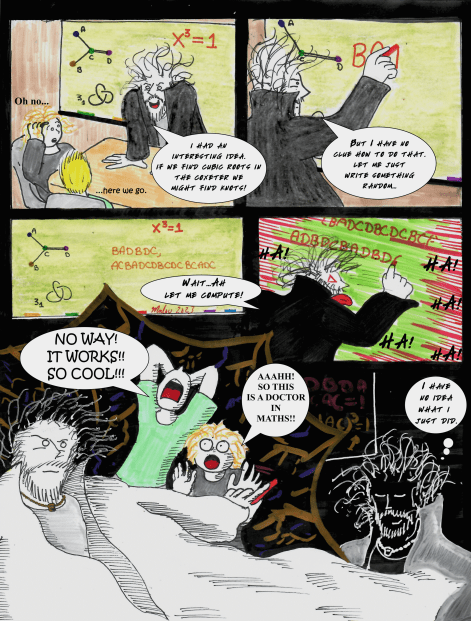
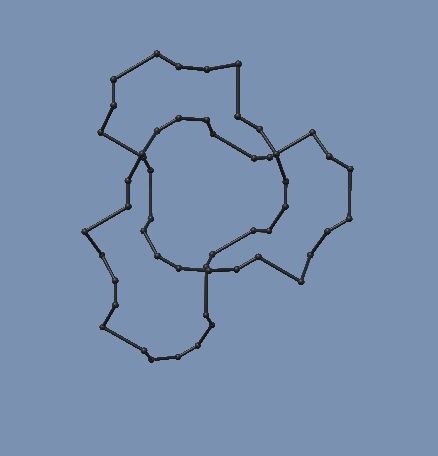
However, while studying this minimality issue, we crossed the idea of whether we could use words of finite order to produce knots with certain symmetry. This led us to study words of order three to produce knots with threefold symmetry. We found quite beautiful trefoils (and very strange trivial knots) in this way.
Special moments I remember 🙂
This team was very united. They would engage a lot with each other and work together a lot. That was very nice to be part of, because I could see how they shared many of the ideas they had. The searches they did for trefoils with symmetry was an incredible quest. I really liked this project’s exploratory feeling: one day we stayed until 10 pm looking for the terrible knot 9_41.
Outcomes of the work
The students presented their work in the CUMC 2023 in the University of Toronto. It was very well received work.
At the moment of writing this, we are writing our results, and we hope to submit soon.
 Malors